|
8. The Suppression of the Monasteries In Bristol three monastic houses came within the terms of the Act, but St James's Priory escaped closure because it was a subsidiary of the large and wealthy monastery at Tewkesbury. St Mark's Hospital also survived because it claimed exemption as an almshouse, even though it had been visited as a monastery by Richard Layton in 1535. Only the tiny nunnery of St Mary Magdalen at the foot of St Michael's Hill was closed by the Act. There were only two nuns, one very old and the other a novice, with a manservant and a woman laundress. Like all the other suppressed houses, the buildings, property and income of this nunnery were confiscated by the Crown. A new government department, the Court of Augmentations, was set up to deal with all the new wealth coming to the Crown, and local commissioners were appointed to supervise the closures and sale of property. In Bristol the commissioners were two prominent merchants, Thomas White and Nicholas Thorne. They reported that the two nuns at St Mary Magdalen were by report of honest conversation, whereof one [is] professed being impotent and aged, the other a young novice desiring continuance in religion'. The nunnery was not in debt, but the house and its contents were very poor. The nuns were expelled and their fate is unknown. The servants were dismissed, and in 1537 the house was turned into a private dwelling and leased to Dame Joan Guildeford, widow, for 21 years. (Public Record Office, SC 12/33/37; Letters & Papers, Henry VIII, XI, 307). Having secured a large increase in the wealth of the Crown from the suppression of the smaller monasteries, Cromwell now turned his attention to the friaries and to the far greater prize of the larger monasteries. The Suppression of the Bristol Friaries The four orders of friars in Bristol had little wealth and scarcely any property except their churches and friaries, as they were forbidden to possess lands. They were, however, powerful preachers and continuing small bequests in wills show that they remained popular. The task of persuading' the friars throughout the country to give up their way of life and voluntarily' to surrender their houses to the Crown was entrusted to Richard Ingworth, who had been a Dominican friar. He arrived in Bristol in July 1538. The Bristol Carmelites, whose friary stood near the site of the present Colston Hall, surrendered easily. They were heavily in debt, and their prior had fled, taking most of the valuables with him. Suppression of the Carmelite Friars of Bristol , July 1538.
Richard, Bishop of Dover's description of the Bristol Carmelite Friary, July 1538
(Sources: T. Wright, Letters, Camden Society, 26, 1843, 202-3; G.E. Weare, Collectanea, Bristol, 74-75.).
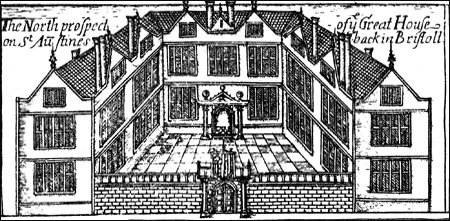
Illustration of Sir John Young's Great House' The three other Bristol friaries were unwilling to surrender, and Ingworth reported that they were stiff' in opposition. Finally, on 10 September 1538 they succumbed to pressure and all agreed to surrender. The number of friars in each house at the time of their suppression was as follows:
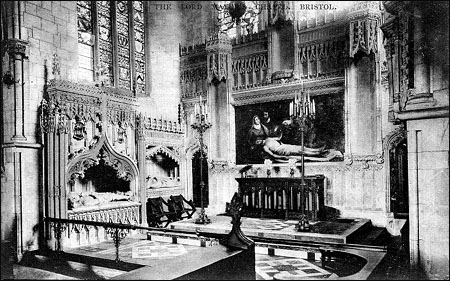
The Final Suppression During the years 1537-39 the remaining monastic houses throughout the country had been under pressure from Cromwell's commissioners to surrender voluntarily' into the hands of the Crown. In return the monks and nuns were promised pensions and favourable treatment. Many accepted the generous terms offered and gave up the religious life, but in Bristol the two houses of St Augustine and St Mark held out until December 1539, while St James did not surrender until January 1540. Remarkably, although throughout the country monasteries were surrendering and the religious communities were being dissolved, at St Augustine's a new abbot was elected on 24 August 1539. Abbot William Burton, who had been in office since 1525 died in July, and a month later his successor, Morgan Gwilliam, was chosen as abbot. He had previously been the prior. Three months later, on 9 December 1539, the new abbot and eleven canons surrendered the house to the royal commissioners and were awarded pensions. The abbot received the generous pension of £80 per annum, as well as the abbey's manor house at Abbots Leigh. The canons' pensions ranged from £8 to £6 per annum according to seniority, and each received an additional gift of £2 as an extra inducement to surrender. The forty-six servants employed by the abbey were given their wages and dismissed. The list of possessions of the abbey reveals its wealth and splendour: 126 tons of lead on the roofs. (L & P Henry VIII, XIV (ii), 660) On the same day, 9 December 1539, the royal commissioners received the surrender of St Mark's or the Gaunts Hospital. The master, John Coleman, received a pension of £40 per annum, and three priests were awarded £8 0s 0d, £6 13s 4d, and £6 0s 0d per annum respectively. In addition a total of £10 9s 4d was paid to sixteen men, children, choristers and servants, all of whom were dismissed and evicted from the hospital. In May 1541 the site and much of the property of St Mark's, together with other monastic property in Bristol and Somerset were purchased from the Crown by the mayor and corporation of Bristol. This far-sighted purchase meant that for the future Bristol enjoyed a substantial annual income from rents; it also meant that St Mark's church became the Lord Mayor's Chapel.
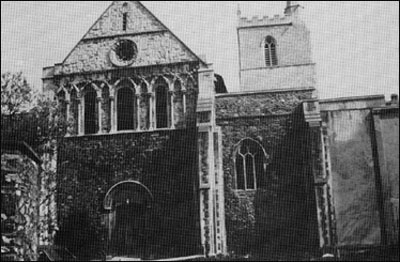
Interior of St Mark's St James's Priory held out until 9 January 1540. This was because it was a subsidiary to Tewkesbury Abbey which was one of the last west-country houses to be suppressed. The prior, Robert Cicestre, and two monks of St James's priory were granted pensions by the Crown. It seems likely that they had anticipated the closure, since much of the property had been leased to a royal official, Anthony Kingston. The chancel of the monastic church and the buildings were rapidly demolished, but the nave survived because since 1374 it had been used as a parish church. When John Leland visited the site of St James's Priory early in the 1540s most of the buildings were already ruinous. He wrote that, It standeth by Brode meade by northe from the Castle on a hilly ground, and the ruins of it standeth hard buttynge to the easte ende of the paroche churche. This St James was a cell to Tewkesberye'. The large churches belonging to the friaries were also rapidly destroyed. The new owners, who had bought these buildings from the Crown, sought to recoup their outlay by selling the lead from the roofs, the cut stone and the tiles for building work, so that the once-splendid buildings very quickly became ruins. The churchwardens' accounts of Bristol parish churches show that they used the former religious houses as convenient sources of building materials, especially during the reign of Queen Mary, when they were required to replace so many of the furnishings which had been destroyed during the previous reign. (J.H. Bettey, Bristol Parish Churches during the Reformation, Bristol Historical Association, 1979; L & P Henry VIII, XIII, 322).
St James's Priory Many former monks secured positions as parish priests or curates; some became chantry priests until the chantries were dissolved in 1547. For example, of the eleven former canons of St Augustine's, Bristol, five became parish priests, three were curates, two served as chantry priests, and the abbot, accompanied by one canon, departed with his pension of £80 to live on the Isle of Wight. The younger and more energetic monks may have welcomed the opportunity to escape from the narrow confines of the cloister. For the older monks and nuns, moulded by a lifetime of ordered monastic routine, the dissolution must have appeared as a disaster.
NEXT
|