|
5. Conclusions During the 'Air War For England' the Luftwaffe claimed that 1237 tonnes of high explosive and oil bombs, plus 248 tonnes of incendiaries had been aimed at the city during the course of ten significant attacks, and that their maximum effort had taken place on the night of January 3rd 1941 when 178 bombers dropped 208 tonnes of high explosives and incendiaries. Nevertheless, when these figures are compared with the Allied bombing of Germany it becomes immediately apparent that the Luftwaffe, designed as a tactical weapon operating in close support of the army, and devoid of a successful four-engined bomber, had in fact never possessed the necessary equipment to succeed in a long drawn out strategic campaign. In the final analysis a lack of suitable equipment coupled with an inability to realise the importance of quickly following up any attack, dogged the Luftwaffe throughout the war, and when one takes into consideration Britain's ever improving air defences, we have probably identified the most important reasons for their lack of success. The top priority, the destruction of the docks and their associated industries had been a complete failure, the workings of the Port of Bristol only being interrupted for one day in the four years of the bombing campaign. Likewise in attempts against the local aircraft industry, and in spite of serious damage being caused by individual attacks, the delays in production, although more than just a nuisance, were made up relatively quickly and output went from strength to strength as the war progressed. This was helped by the fact that there had taken place no serious breakdown of civilian morale anywhere in the area in spite of the 561 'Red Alerts' which had sent people scurrying to the air raid shelters between June 25th 1940 and June 13th 1944. One of the more lasting effects of the campaign, however, was on the townscape of Bristol and at the end of the war Bristol City Council announced that 89,080 properties had been destroyed or damaged by enemy action, and this included 81,430 dwelling-houses and shop flats, of which number 3092 were either totally destroyed or subsequently demolished. The most serious result, however, was the loss of life caused by the raids, and tragically a total of 1435 people were killed in the Bristol, Filton and Yate areas, with whole families being wiped out and others ripped apart. No census was taken in 1941, but using the 1951 figures it can be calculated that this represents approximately 0.34% of the population, or about a 1 in 300 chance of a Bristolian being killed by Luftwaffe bombs. Sad though this loss of life was, it pales into insignificance when compared with that suffered by German cities. An example being Dresden, where on the night of February 13th 1945 some 50,000 people lost their lives, the result of 805 British bombers having dropped over 1400 tons of high explosives and about 1200 tons of incendiaries, more than fell on Bristol during the entire war! Although more effective by day, there is little doubt that Bristol's air defences as they existed at the start of the raids in June 1940 were totally inadequate for so important a target. Only six heavy gun sites were operational around the city, and while the balloon barrage was almost up to strength, the new local fighter group was only just being established and was for some considerable time forced to operate from totally inadequate airfields, and to attempt night interceptions with unsuitable aircraft and no radar guided ground control. No Bofors guns had yet arrived to protect the important local airfields and aircraft factories, the outer searchlight areas were undermanned, and a radio counter-measures and decoy organisation had yet to be formed. This unfortunate situation was not, however, confined to Bristol, but existed throughout the country and was very much due to a pre-war policy towards rearmament which resulted, from the air defence point of view, in "too little too late" both in terms of men and equipment. The losses sustained at Dunkirk also needed to be made up, and right through the 'Night Blitz' of the winter of 1940/41 the Bristol area was in fact without any real protection from German bombers. Nevertheless, in spite of their inadequacies the local defences certainly did not go unnoticed by the Germans. As early as the end of June 1940 aircrew returning from nocturnal sorties had confirmed a balloon barrage flying at 3 to 4000 metres in a half circle about Bristol, with another at a similar altitude to the north of the city. Strong searchlights and heavy well laid Flak were also encountered, and this continued to be the case for almost a year. Furthermore, on the night of December 6th decoy sites were first noted in crew reports and were thereafter regularly mentioned in a variety of forms, a few even being said to resemble triangles. Among the large number subsequently reported in the Bristol area some burnt with a reddish colour, while others appeared to contain magnesium fires or lights which pulsed on and off. Notwithstanding a small number of night fighters had also been encountered over the area since mid-August they initially posed no threat and it was not until early April 1941 that Luftwaffe documents first record bombers returning from Bristol with combat damage caused by cannon armed interceptors. It is therefore ironical that by this time, just when the application of the latest technology coupled with the arrival of sufficient suitable equipment was at last giving the defences the power to cause problems for the Luftwaffe, the majority of their bombers were about to commence a move to the Eastern Front, from which most never returned. From late 1941 onwards, in spite of the constant transfer away of many fit and able men from Balloon and Anti-Aircraft Command, the local air defence system was expanded and improved to such an extent that by early 1944 it was able to inflict unacceptable losses upon the Luftwaffe, which was now totally incapable of causing any disruption to the war effort in the Bristol area. Although no invasion of Britain ever took place, or was really ever likely, the Home Guard was nevertheless important to Britain's war effort in a number of ways. In the early years, and especially in the spring and summer of 1940, it gave people a means of direct participation in the defence of both the nation and of their own locality, and therefore becoming truly involved in the tumultuous events of the day. Moreover, even as the importance of the Home Guard declined in proportion to the perceived invasion threat, the force became important in other ways. It was, to begin with, a useful observation tool in 1940/41, but more importantly, as the war progressed and the manpower pool was depleted, the Home Guard provided a ready source of stand-in troops, allowing at least 100,000 specialist troops to be transferred to more aggressive tasks.
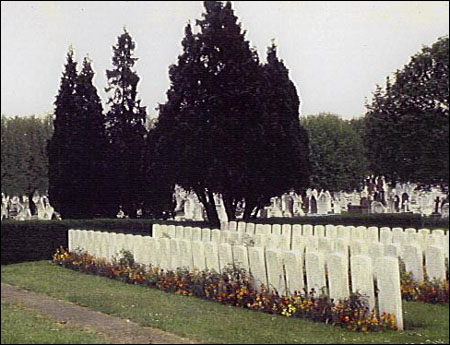
Greenbank Cemetery, Bristol It is, however, individuals who made up the various formations of attackers and defender and today few people can be failed to be moved by the sight of personal monuments to the victims of the Second World War, especially the neat rows of graves in Bristol's Greenbank Cemetery, where both British and German lie side by side. With the passing of time the numbers who mourn them will dwindle, but hopefully the memorials will remain, to be tended by future generations, as a tribute to their sacrifice and as a constant reminder of the appalling consequences of armed conflict.
NEXT
|